Tuesday, November 21, 2006

Daily


I'm aiming to post something on here daily at the moment. I've got two weeks off between jobs, which should allow me - theoretically - to concentrate on being creative. However, I think I'm still just getting used to the removal of the daily discipline of working hours: yesterday I kept feeling as if I should be 'doing something' - that non-specific sense of being driven, and time-limited. Must try and relax. That's R-E-L-A-X, Andrew.

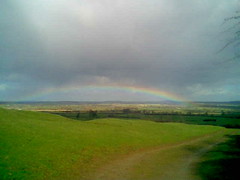
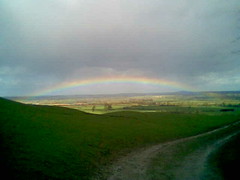
(Managed 10 miles on my bike yesterday, and stopped for a few minutes halfway through the - chilly - ride, looking out over a rural landscape that fell away in a mixture of pasture, copses, cows and sheep and ramshackle sheds and fences, down to a streambed and then back up to some hazier fields and woods in the distance. I could hear cows bellowing and rooks cawing, and the distant drone of an invisible light plane.)

Monday, November 20, 2006

Being Still


Everything's moving, too much
Flowing and spinning past,
But, once in a while,
You turn your head and look out
Through the window of the fast-moving train
And the blurred confusion of the night-darkened
City's brick walls and lighted back windows
Pivots past, controlled, like meshed gears,
And you see the trackside room whole,
Profoundly clear and impressed.

Sunday, November 19, 2006

Casino Royale


The last Bond film I saw at the pictures was Live and Let Die. That would have been in 1973, at the Ealing ABC, I think. Between now and then, if you'd asked me to characterise Bond films, I would have thought of Roger Moore's stiltedly-arched eyebrow, and his knowing eye contact with the camera: that camp self-awareness and self-referentiality, coupled with schoolboy-level sexual titillation, misogyny, borderline racism and unconvincing big bang special effects whose aspiration outstripped their execution. So the pleasure of the Christmas Bond film paled after I hit 16 and started to develop some critical faculties and became aware of the cultural orthodoxies that were embedded in these 90 minute chunks of glamourous hokum.

So I came to Casino Royale with a rather fuzzy set of expectations. This was to be the last cinema-social with some old work colleagues (Friday was my last day at work with the company), and I'd agreed to go entirely as a social thing, rather than in any expectation that the film might be any good. I'd deliberately avoided reading the reviews.

Despite those loose expectations, I was very pleasantly surprised to find that: (a) it was very good; (b) I enjoyed it; and (c) most of the Bond cliches that I'd come to despise were gone. (And no Q and his ridiculous gadgetry.)

This Bond film sets a different tone right from the outset: a double killing that sets Bond on the road to his '00x' status. The violence here is not stylised or casual, but mechanical, earthy and effortful - blood, sweat, dirt and fear (to paraphrase Churchill). This monochrome segment establishes a hard-edged realism that the rest of the film (mostly) echoes: it's played pretty straight, with a few ironic self-references that are neither mugged nor telegraphed as of old. True, there are some elements that don't really stack up for me - the main romantic relationship felt to me as if it was never quite effectively established, and the functional poker game sequences are a little dreary - but as a straight thriller, this is pretty thrilling, with some excellent action sequences that really demand to be seen in a cinema with a big sound system.

And beyond all that, Daniel Craig and his impressive pecs manage to imbue James Bond with character, and with real humanity. That's quite an achievement, I think. I went into the theatre thinking that the film ran for 90 minutes, when in fact it's 140 minutes. I see it as a very good sign that it never occurred to me to think that the film was overrunning. Recommended!

Call me Bridget


Hm. Got on the scales yesterday, and my series of 'leaving work' dinners and evenings out have really taken their toll: I now weigh the same as I did about 5 years ago, when I decided that 'that's it!' and went on to lose 3 stone plus. I swore that I would never go back to that weight...but it accumulates, dunnit?

I now need to repeat that earlier weight loss, as I now see myself as prime heart attack material. Hence these pages will carry notes about the number of cigarettes smokes/drinks consumed/miles run or cycled, as I track my progress from vast porky bloater to healthily slender normality (I'll work on those pecs later).

Today: 0 cigarettes (v. good), 1 hour's walking, 1 hour's cycling, alcohol units = 10 (v. bad). (OK, I never smoke, but it's a real positive, innit?)

Thursday, November 16, 2006

Dreams


I will look into dreams more, I think: I was thinking about them in the bog today while I watched the cloud-dodging light flicker on the pebbled glass. Dreams are everywhere you look in literature, in film, in TV shows. Clearly I haven't made a study or anything, yet, but what strikes me is that dreams are universal, and that they reveal things to us that we already know (but can't acknowledge openly to our waking selves), or they tell a story that contrasts or echoes the main narrative, or they make the protagonist feel weird. (I'm sure there are more functions served, but those are the only ones that spring to mind at the moment...)

Anyway. What's interesting to me is how all this must be rooted in the electrochemical activity of our brain matter, and how different we become when we are asleep (or very drunk), when the 'editor' of consciousness - and the filterer of the permissible, the acceptable and the sensible - takes a break, and all the stuff that's kept at bay during the day is allowed out to play... And, of course, if this 'conscious' self - this 'I' and 'me' - is (as I believe) merely a construct of the underlying systems, then the stuff you get in dreams is closer, possibly, to the 'true' 'I' that's embedded in all those synapses and neurons. (But ah, you might argue. the sleeping 'I' who sees all of this 'unacceptable' material is just another construct from the same source...so where does that leave you? Good question.

Books, must buy books on this. I feel another monomaniacal frenzy coming on.

Gabriella


When I woke up, the room was almost totally dark, the gauzy curtains breathing gently at the window. Something about the intense fixity of the quiet outside, and the absolute stillness of the building, told me that it was very late – the middle of the night. I still had my clothes on, and my body felt achey and bent from where I’d fallen asleep in an awkward position. My eyes were taking in the fragments of light and shade, and I could feel my ears straining to pick up sound, but I wasn’t yet fully present in the room. It felt as my brain was struggling to catch up with my body, as if they’d been separated from each other and, surprised by wakefulness, were seeking each other out in a confused haze.

After I’d undressed and pulled the thin cotton sheet up to my ears, the rest of nanny’s story started to echo in my mind, although I wasn’t really sure which parts I remembered from the actual telling, or from previous tellings, or from the additions and distortions of my own dreamwork. In the darkness, feeling overtired but not ready for sleep again, the pieces of the story danced around each other but never quite met.

“While she’d been walking by the river, the moon had been hidden behind the hill, and by the ring of trees on the hilltop. She now crossed the bridge, from the meadows over to the cultivated fields, and the moon rose above the hill. There’s soon enough moonlight to cast blue-black shadows on the silver-grey dust between the cornrows, and the hedges are inky with shadow too. The woods are black, smeared across the hillsides above the curve of the lane. Most of the village is still in the moon’s shadow, between the shoulder of the hill and the [Hanging?] Wood.

Wednesday, November 15, 2006

Good Grief


Like Gabriella, I get very annoyed when I listen to our political correspondents as they nobly unravel all of the 'complexities' for us. Christ! Beyond Norman 'Cliche machine' Smith on the Today programme - a man who spouts more uncompleted metaphors in two minutes than even I'd thought possible - we have John Pienaar, who seems to think that we're as interested as he is in the minutiae of the Blair/Brown relationship, and who can still use the phrase 'big beast' in apparent seriousness.

If you wonder why people are disillusioned with politics, listen to these two and to Nick Robinson: once upon a time, it seems that political life was focused on doing stuff. Now - if the mainstream coverage is anything to go by - it's about soap opera, and about a self-absorbed obsession with presentation and surface issues. Hardly news, but still irritating and pathetic. All that surface coverage leaves no room for substance.

Gabriella


“The little girl set off for home,” nanny Anna went on. “She walked beside the river, heading for the old stone bridge. She could hear plops and splashes as little creatures went about their business in the rushes by the banks, fur and feathers whispering against the reeds and the sun-dried grasses. The sounds of the little animals and birds comforted her, and made her feel less alone in the twilight.

“She paused by the bridge, staring into the black shadows where the river ran underneath, not looking for anything in particular, but just looking at the darkness as if she half-expected something to emerge from it and break the spell. During the daytime, with the sun shining and with light at the other end of the tunnel, the space under the bridge was cool and nice, a good place to rest and listen to the water tinkling by. The boys and girls would paddle there, stepping in and out of the shadows, and picking their paths across the river by the broad stones planted in the shallow water. The stones and the gravel were all different colours – white, orange, brown, grey, bluey-black – and, in the daytime, the moving water made the light ripple and pulse over them.”

Nanny’s voice sounded as if it had changed, somehow. The flow of words was just as smooth as always, but it sounded as if she had abandoned a written text and was making up her own story as she went along. I sort of liked that, because it made me think that the story could be different this time, with a different ending, but at the same time I felt slightly worried that the familiar features of the story would be left out [and I would…???].

As nanny read on, I sometimes leaned against her, and my eyelids drooped and closed, but the words kept coming out of nanny’s mouth, and I heard them with my ears and felt the vibrations of nanny’s voice through her ribs and chest, and through my skull resting against her body. The warm smell of nanny and the oily perfume from downstairs lulled me towards sleep.

Tuesday, November 14, 2006

Gabriella


[It may be that she’s drinking here, and trying to think straight]
The thing about what that composition teacher told me – about the rules about what we should write – the thing about it is that it wasn’t the rules that really seemed important to me (although they were, in a way). No, it was what the fact of those rules implied, and what it meant for me to be told these things by that teacher.

Let me try again: what I realise now is that I was so
accepting in those days. Whatever anybody in authority said must be true in some way, even if it didn’t fit in with what I’d learned through my own experience. I knew that there were sources of authority that were unquestionable – though I wouldn’t have put it like that back then, of course. I knew from my family upbringing that here was always a ‘man who would shout at me’ if I transgressed – for example, by drawing attention to the family in a public space, or entered a building through the wrong door, or jumped a queue – even accidentally.

I’ve forgotten all the specifics of those lessons and directions, and anyway, it was the generic lesson that was important. The lesson of the existence of externally-imposed, independent standards of excellence and behaviour – standards that wouldn’t live down to me, but which I had to live up to.
And I had no choice about that.

Let me try again. I was never conscious of this. I just spent…a series of moments, reacting to what was put in front of me, trying to do what I thought was the right thing – the thing that would make people like me, or which would make them happy (or at least not
unhappy). I have an image of acting, and then looking over my shoulder to check that what I had done was OK. And even when there was no adverse reaction, I was still not quite sure that I had done the right thing. The absence of censure/approbation (?) was no guarantee of increased confidence.

But what am I trying to say? It’s so difficult to think about the things that have become the basis of your behaviour over years and years, because the neural circuits that you’re using to do the thinking are dependent on – and partly composed of – those strata of circuits and protein and blood vessels…the tangled meat machine is trying to separate itself from itself so that it can look back at itself and report back to itself. Hah!

Fuck. What I mean is that I learned that there were higher things. Things that I knew second hand, but which were unquestionable. The unimpeachable authority of the things that weren’t me. They were everywhere you looked. So I did the right things, and behaved myself, and followed the conventions, and didn’t draw attention or make a fuss, even when people fucked me over, or served me crap food in a restaurant – I’d smile and say it was ‘fine’. And where has that got me? Fucking nowhere. Teachers, lecturers, journalists, managers, politicians, authors, film-makers, musicians – I thought that they all had the kind of special knowledge that I couldn’t ever get access to, mysterious stuff that lent them authority and credibility. Now I can see that that was all crap. I was just building myself an inferiority complex that kept me powerless and opinionless. All those wasted years when I was being a good girl and living to other people’s standards, thinking that they were my own. Fucking idiot.

You just have to listen to the radio in the morning, all those voices employed by our most august national broadcasting institution, privileging their narrow editorial focus – obsessions – through repetition. Ten years ago it was business, business, business – all the time: that was the thing that was most important to everybody – acquisitions, mergers, share issues and rumours boardroom changes. Today it’s the internal politics of the government and the intrigues and posturings of ministers, all trying to outsmart their interviewers and prove that whatever they’ve said or done, and whatever changes of direction they’ve made – they’ve
always been right. Crap. And the posturing extends to those so-called rottweiler interviewers, whom we’re supposed to admire for taking these shifty bastards to task on our behalf, but who are really just going through the motions of their limited repertoire of studied incredulity and automatic gainsaying – the same generic questions with a thin veneer of topical detail (courtesy of a background researcher) which never really probe, because the interviewer and the interviewee know what the rules are, and that there’s only a three-minute slot, so you’re not going to crowd a proper exploration of any kind of complex issue into that time, are you? You make your points and I’ll pretend to press you. Shit. Shit. Shit. Pointless shit.

Monday, November 13, 2006

Gabriella


“Not long ago,” nanny Anna would begin, “there was a little village tucked into a hollow between a hill and a forest, and a little river winding between the houses and the fields. And in the fields there were horses and pigs and cows. The people who lived in the village were poor, but they were happy, because their houses were made of brick and stone and they were safe and warm, and the fields were green all summer long. At harvest time, all the villagers would help to gather in the harvest, and everyone would be well-fed through the winter. And so the village lived peacefully and happily for year after year.”

The first time nanny told me this story, I thought that the story had ended when she got to this point, and I said, “Goodnight, Nanny,” and turned to my pillow. The story as it stood seemed to me to have all the story components that I was used to, and a balanced, natural arc – some scene-painting, a sense of place, and everyone living happily ever after, with a peaceful sun setting over the generous fields. On subsequent tellings, however, I had a sense of the gloomy challenge that was coming to the village, and so I always felt a little sad for the people who lived there, knowing as I now did that their happiness would cloud over and that the sunlit village would be deluged with troubles.

The substance of the story that followed nanny’s prologue is lost to me now, although I still have some fragmentary images in my mind, all associated with the crisp, fresh smell of nanny’s sun-steeped cotton dress and with the play of reddening evening light on the pale wood and plasterwork of my bedroom: I can remember a cruel, rich man in his manor house on the other side of the forest, who took more than his share of the crop; a disastrous flood that ruined the harvest; hordes of starving soldiers returning from the war, marauding across the landscape in the autumn, carrying off what food there was and killing the animals for meat. And I recall the feeling I had, even then, of mingled dread and puzzlement. It seemed so unfair that these blameless people had so much trial and suffering visited upon them, when all that they wanted was to live in peace and wait for the next season to come around.

Sometimes, when I was feeling irritable or overtired, it seemed to me that nanny was somehow partly to blame for this/these unfairness/injustices, especially as there was so much hushed enjoyment in her voice as she detailed the pains and misfortunes, too much deference for the rich man and his damaging, whimsical demands, and too little sympathy for the little boy and girl who drowned, glibly and quickly, in the rain-swollen river, seemingly punished for their perceived naughtiness. And there was something particularly discomforting about the relish with which she told the final part of this often-repeated story, the part whose approach I both dreaded and anticipated with excitement, the part where the horror and fear made me tingle, wide-eyed, in the dusk.

“Late one afternoon, on the longest day of the whole summer,” she’d continue, “a little girl sat alone on the river bank. She had been cruel to her friends, and they had all left her and gone home for their supper and bed. This little girl’s mummy always had to work hard, because the little girl’s daddy had been killed in the wars, and so the little girl knew not to go home until mummy had finished all of her cleaning and sewing for the lord of the manor. All this work made the little girl’s mother sleepy and forgetful, and the little girl didn’t have to be good like the other children.”

I felt sorry for the little girl – especially that she didn’t have a father, like me. I felt close to her. I snuggled my head against nanny’s soft stomach and bosom, trying to burrow in tighter. Nanny paused and breathed deep in the sudden silence and stillness of my room. Outside, the city streets were evening-quiet, and the sun was setting: it was already well below the rooflines of the opposite apartment blocks. Nanny put her arm around me – I remember the feel of the soft, slightly clammy skin of her upper arm against my bare shoulder – while she shifted us both around so that the sun’s afterlight glowed on her forehead. She seemed to stare off into that fading light, looking at something I couldn’t see, while she continued.

“The little girl had been playing on her own on the riverbank for a while after her friends had left, and when she found herself yawning and yawning again, she thought that she would have a little nap under a tree for a while.

“And of course she fell asleep, and while she was asleep she dreamed a strange and frightening dream. In the dream, she woke up under the tree, and it was late. Very late – nearly dark. There were few stars out already, and some thin pink clouds still in the deep blue sky. She felt cold. There was a breeze blowing, rippling across her thin cotton dress and making the branches of the tree sway, the leaves all rustling and looking white in the dusk. The little girl felt chilly and afraid for a few moments, knowing that it would be full dark before she got back to her home on the far side of the village. But she knew the lanes and the fields very well, and she could see by the white glow above the hill that the moon was rising. The light of the moon would see her home safely.

Sunday, November 12, 2006

Gabriella


One summer, at the time of year when the late afternoon sunlight shines on the closed, faded wooden door of my bedroom, I hear doors downstairs opening and closing, shouts of greeting and laughter, and I know that Grandma Anna (as mum calls her – I call her ‘nanny’) has arrived for one of her brief stays.

I have no idea what mum and nanny do during the day when I’m at school, but in the evening they still seem to be full of talk, talk, talk, all through tea: about people they used to know, places they used to know, and relatives whose names sound familiar but whom I have never met. They try to engage me in their conversations too, but I don’t understand how this kind of conversation works, and I find it boring and effortful, and they quickly tire of my monosyllables and patent lack of interest, and I’m free to go back to my comic book.

As their talk flows across the table, though, and as they drink cup after cup of tea, I [soak up/osmote] an impression of intimacy and shared history, and I somehow resent – despite my boredom – the fact that I’m excluded.

In the evening, after a typical summer supper of cold potatoes, pickled beetroot and a slice of ham, I’ll go up the stairs to bed with the dusk light glimmering on the staircase, and nanny will follow me up later – wheezing by the time she gets to the top – to tell me a story, either reading from one of my books, or something from memory.

Her favourite story, it seems to me, and the one that I’ll always associate with the smell of her soap and sweat, and with her cotton-clad bulk beside me on the bed, is the one that was set – or so she insisted – in the village where she had grown up. This insistence (which I didn’t come to doubt until much later) lent the tale an intriguing degree of immediacy and contemporaneity, and I imagined my nanny as an active, concrete presence in the landscape that unfolded in the story, and I sensed her in the background of the story, going about her everyday life, as she told it.

Sometimes I would tune out of the story and just gaze up at the side of her face as she read, her jaw moving, as the evening faded down and she had to shift the book around to catch the light from my bedside lamp.

Dream


I dreamed I was going on holiday with some old friends and a couple of current work colleagues - somewhere in the West: Wales or Cornwall, I think, with cliffs and big surf and unforgiving rocks. We were staying in a big wooden hut complex, with high ceilings, big windows, and lots of shelves and storage racks of scientific equipment and tools.

Anyway, the most important thing was that I kept waking up with wasps in the hollow behind my (right) knee, and I kept thinking I had them in my hair (ha ha) and on the back of my neck. Oh, and the wasps transformed themselves into vampires at night. eventually, after pulling back the itchy woollen blanket on the metal sprung bed and rooting around underneath, I discovered that there was a wasps' nest under the bed, and that this was the source of the blood-sucking contagion. Sadly, I was already infected, but I was able to help the others create a vampire detector device using some bits of bamboo and some stripped copper wire that I pilfered from the shelves of supplies. Everyone else would be OK, but I was doomed to pass over into the darkness.

(Not sure if this is a dream about changing jobs or about my Messiah complex...)

Something Else...


Gabriella


Sometimes I think that the only things I really know are the things I’ve created in my own head; the ideas that have grown out of my own… ‘felt experience’ – things that are rooted in what I’ve sensed for myself. Richard [the lost, lamented partner] used to get annoyed with me and say that I lived too much inside my head. And he was right, in a way, but I came to see that way of being as a strength, not a weakness. The things that I believe in all come from inside me…they’ve grown from inside to out. Everything else – what people tell me, or what I read in books – feels somehow incomplete and unconvincing…as if it’s all surface and no substance. I can’t absorb it properly, and there’s no nutrition in it. It doesn’t do me any good, and it never truly becomes a part of me.

The disadvantage of this is that I’m somehow experiencing the world at one remove: everything that comes in gets over-processed, interrogated to see how it fits with the core truths that I have assembled internally. And anything that doesn’t fit that internal template gets twisted out of shape (out of existence), or is sceptically/suspiciously dismissed. This applies to other people’s emotions and attempts at close communication, too. So when people try and tell me something about myself, or ask me a question about my feelings (or which touches on them, however obliquely), I’m immediately defensive and prickly, intent on deflecting their focus and on moving the conversation on into a more comfortable area. And, of course, I have no way of checking whether my intuitions about what people are feeling is accurate, or checking if what I feel about them is reciprocated: there’s no way of internalising their messages properly, and no chance of me externalising what I feel. It’s like there’s a shell around me, impermeable and glossy with reflected light.

Richard hated that about me: I could see him trying to chip away at the shell, or try and sidle up to me and take me by surprise and fool me (when I’d been drinking or smoking dope, for example, when he thought he could bypass the normal channels) – but he could never get in. Those channels were the only ones that hadn’t silted up. I have to give him credit for persistence, though. God knows why he stayed with me as long as he did…it can’t have been very rewarding for him.

And so here I am.

Saturday, November 11, 2006

Six Feet Under


Courtesy of LoveFilm, I'm working my way through season 5 (or series 5, as we'd probably say in my country) of Six Feet Under. This has to be the most consistently excellent TV series ever offered - unless you know different? Over five years, the characters have all changed in different ways, while retaining something of the essentials that they started with - this is a messy programme, without neat resolutions. Sure, people say things that sound profound and over-thought periodically, but people do that in real life, don't they? (I know I do - I think about things and concoct little sentences to bring out at appropriate moments, usually under the influence of alcohol, and when I want to impress people with the depth and gravity of my thought.).

Anyway. There's a section in episode 8 (?) where all the concurrent stories (drawing upon everything you know about these peoples' history and character from the previous series) kind of focus together, and everybody's feeling confused/upset/uncertain, and the editor cuts between shots of people sitting/lying awake looking unhappy or distressed, over a soundtrack of k d lang and Jane Silberry singing the latter's Calling All Angels - with its lyric about needing help, and not being able to understand how the world can be like it is, and how to be. And it's just beautifully judged and executed. Lovely.

You'd tell me if I overused italics, wouldn't you?

Something else


My big, fat, miserable novel has been making me fat and miserable again, so I've shelved it (again) for a bit. It's 120k words now, so I don't think I can ever abandon it - there's just too much emotional/physical energy invested in it.

Anyway, I'm working on something else for a bit, and I'm going to post that draft material here. Enjoy.

00.00 Prelude


Two weeks into the winter freeze, the city is shrouded by a pall of fog and icy air that’s suffused with a faint gleam of cold grey light. By the time the muffled church bells strike three o’clock the semi-opaque sky is already dimming, deepening into premature night as the gloom of low cloud, mist, smoke, steam and the condensed exhalations of those toiling in the slush and fog damps the light out of the sky. It’s as if the half-light suspended over the city all day is slowly subsiding, with an exhausted sigh, down into the chilled earth and stone.

The lanterns have been lit down on the waterfront, their light flaring across the ice-clamped river, throwing wavering shadows off the low [contours? plateaux?] formed where the plates of ice have fused. The shadows and dusk seem to scuttle across the deep, dull ice, and little [flurries] of light snow skitter over the roughcast surface, twisting and jack-knifing, almost alive, [like the spasmodic track of a pursued animal].

On the other side of the river, between the ice-locked ancient oak piles supporting the jetties [and wharves], the vagrants are stoking up their braziers, filling the dark spaces beneath the frozen planking with heat, smoke, soot and an [oily? Bituminous?] light that seems to etch the vagrants’ bristly beards in dry point [?], and which fixes their rheumy eyes with cleaner, sharper, harder edges. Hyena-like dogs skirt the fires, all rib racks and scarred muzzles, watching for falling food scraps against the flames’ glow, listening for the rats that scurry over the frozen detritus embedded in the river bank, and remembering vivid blood-and-sinew dog memories of dead vagrants: fresh meat for the pack to sustain them through the long winter night.

In the riverside stores and bars higher up the bank, smeared around the dark flanks of the city, the lights are shining out yellow, smoky and warm, beckoning in the chilled workers as they make their journeys home. Time passes, the crowds gradually thin out, and the horses and carts that have plying the business streets disappear. Chimney smoke gradually pales against the sky as the darkness comes down, and frost starts to glitter on slate roofs. Windows are shuttered against the cold. Distant dogs bark.

In the dark and the haze of cold, the more distant lights of the city falter and twinkle.

01.00 Gabriella


Why do I keep letting myself get dragged down like this? Why does that happen all the time? It’s the little things. All the details. Christ, my nails… bitten ragged and sore again. Fuck, fuck, fuck.

This is all true. All of it. But I have some stories I tell myself – the ones that help me make sense of everything. So do you, though. It’s not as if you’re any different from me. So don’t judge me.

In the year they let me stay at the grammar school, our composition teacher taught – no, told us – some rules, one of which was don’t start your story by describing the weather. But I remember the weather, so fuck him. Fuck all of the teachers at that school, in fact.
I’ve forgotten places, names, people’s faces, whole years – but I remember the feel of hard rain on my head and the smell of the city under fog in the middle of winter.

The way into my childhood – into the winters when I was a girl – is the glow in the sky after sunset, seen through the kitchen’s high window, with the metal frame silhouetted against the chill sky – all faded blue, purple, turquoise. I’d have my supper in the kitchen after school – usually it was toast or bread and something: sardines, cheese, sausages. Monday night was boiled eggs…two of them. With white bread, buttered cut into strips to dip. That was my favourite meal.

Sometimes, in the winter rain or slush, my stockings would still be wet from the journey home. My mother laid out a clean pair for me every night after I’d gone to bed; I didn’t have access to the clothes cupboards, and had nothing else to change into in the evenings before my bath. So I’d sit with damp feet until the grey school stockings dried out. I’d twist my toes against the wet wool, and they’d get sore and itchy. I remember a funny feeling when I curled and arched my toes in a certain way, and the bones seemed to lock, seize up. It gave me a funny mix of feelings – hurting and laughter-inducing together. That kind of feeling – like when you’ve got an insect bite that you have to keep scratching, even though you know that it’s going to hurt like hell when you stop – always makes me think of that little kitchen with the yellowish lamps lit and my mother stirring something on the electric stove, and me at the table reading the labels on the sauce bottles or jam jars, or looking up at the window and seeing the kitchen lights reflected there, high up, and the roofs of the houses opposite, dark at the bottom of the window, and the lighter sky above.

Trying to remember those evenings, to search out the details and bring them back – capture them for a moment and look at them properly in the right light – is like scratching that itch: trying to bring the thing to completion and hold off the moment when you stop, and it disappears back into the fog. I remember trying to see the world outside and the kitchen reflections at the same time, trying to make my eyes register both things at once – but I never could: it was always the reflected yellow light, ceiling and cupboards, or the roofs and the paler sky.

My room was right at the top of the building, up several flights of bare wooden stairs, separate from the kitchen and the bathroom on the ground floor. The staircases were gloomy even on summer evenings, and almost lightless in winter; in winter, I felt my way slowly up to bed, my feet probing the tread distances and my palms skimming the banisters, walls, and doors that acted as my landmarks on what sometimes – only sometimes, though – felt like a long and frightening journey through the dark.

The staircases and landings were shared with the other roomers in the building, so I heard different voices as I climbed the stairs, the sounds seeping through the gaps at the bottom of the heavy wooden doors whose sunken panels were so familiar to sight and touch. (When I think of those doors, I can still feel the little mental lurch I got when the panels dropped away from my fingertips, leaving me adrift for a moment.

Different smells dominated different landings, and different stages on the climb: floor polish, pipe tobacco smoke, boiled ham always on the second floor (where you had to take care not to knock over the precarious stack/tepee/pyramid of umbrellas and sticks), stale fat and fried onions. On the last half-landing below my little room there was a funny sweet scent like incense and rich ladies’ perfume and creamy vanilla candles. In the winter, when the landlord’s men sealed all the windows shut, that rich smell stayed in my nostrils even after I’d climbed into bed under the cold, stiff sheets. Sometimes I’d wake up in the night and it would still be there, up my nose, even under the covers, lingering in my snot and little hairs.

One winter night I was waiting for the bed to warm up, trying to keep my arms and legs motionless so that they wouldn’t touch any of the still-chilly cotton beyond the outline of my body. I remember that there was a little bluish moonlight showing at the top of the heavy curtains, and I knew that there was already ice inside the window – a thin patina/layer on the glass and a smooth beading where the glass met the frame. I’d looked before I got into bed, and felt the beaded ice melt flat against my fingertip. The moon had been higher up then, full, and very white and strong in the cloudless sky. That whole side of the sky was so brightly lit that I couldn’t see any stars, just a big sky of graduated grey blue, with the dazzling moon at the top of it. The frosty rooftops stretched away, slates and ridgelines crisp like cast metal edges in the clean light, and here and there I could see yellowish lights in tall towers, [mesmerically attention-drawing] against the silhouette backgrounds of dead stone and brick. From my bed, when I looked at that silvery [gauze] of light above the curtain, I pictured all those roofs, and the great blank light glaring [dumbly] down on them, and I thought that all those roofs would have rooms like mine stacked beneath them, with children in them trying to keep warm in cold beds, and adults in the rooms below, eating their dinners and talking in and out of the sound of metal knives and forks on thick china plates, their voices rising and falling, the words always unclear to the children upstairs; just the rhythms and tones of familiarly indistinct, distant voices lulling the children to sleep.

I was jealous of all those other children, who had a mum and a dad to listen to through the floor – when I just had my mum . Remembering this, and picturing my little girl self, I’m tempted to see chill, reluctant little tears glinting at the corners of my eyes in the faint light. That would be a lie, though – a self-pitying adult invention projected back onto little me. As far as I remember, I was just jealous. Not sad.

Lying in the cold and dark I felt – just for a moment, but very clearly – the memory of warm sunlight on the skin on the inside of my forearm, and smelt the smell of sun-warmed skin, that dry, [intoxicating?] odour of spring. The sense of being back there in the [warmth] of May was so real that I thought I could almost see the sunlight on the wall at the foot of my bed, an even spread of light on the custard-coloured paint. Then the [sense-] memory was gone. Trying to recreate the sensations by focusing on the light, the wall, the separate feel and smell of skin, I found that I could bring back each element in isolation, but never conjure them up simultaneously in a single assembly that suddenly locked [in focus] and vibrated, alive and whole, in my mind. I circled round these fragments as they snapped in and out of [apprehension/comprehension], each fragment of lost attention careening away from my fragile grasp, immune to my appeals for it to stay.

Blogjam


The blogjam is over.

Urged on by audience feedback, I have decided to apply the cattle prod of discipline to the vast immobile backside of my bovine lack of creativity. (Thank you for the prompt, S.) Once again, tenuous extended metaphors will send their weedy tendrils out towards the edge of the page, gradually attenuating until they cannot grip any longer, when they will inevitably curl up and die of vegetable matter-based embarrassment. Just like that.

More later. Really.

Wednesday, November 01, 2006

A Rubbish Joke What I Made Up While My Soup Was Undergoing Its Second-stage Microwaving. You'll Despise Me For Taking The Time To Type It In And Wasting YOUR Time Too. Especially Galling Will Be All Of These Capital Letters For No Reason


What do you call a listless Frenchman who plays for Arsenal?


Thierry Ennui.


See?

Friday, October 27, 2006

Marie Antoinette


Do yourself a favour: don't bother going to see Marie Antoinette. If you must go, take your iPod and listen to some music. That way you can ignore the slacker accents, the unconvincing acting, the knowing ironic lines - oh, and the sound of clunky metaphors thudding to the floor and the music soundtrack telling you what the characters are feeling. It looks pretty sumptuous, though: beautifully sunlit forests, fine buildings, lovely frocks, grand ceilings, and wonderful staircases. Sumptuous but vacuous. And so dull and unconvincing: the film seems to spend so much time being ironic that it forces you not to care about any of it, or any of the characters. I struggle to see the point of telling a story about dim people living empty, protocol-constrained and vacuously hedonistic lives unless you're going to make us sympathise with them in some way - but this film is so lacking in any psychological realism or depth that you really can't care at all. I was already looking at my watch after 45 minutes.

Low points: "Fools rush in" on the soundtrack to indicate that she's smitten with a Swedish soldier; a fountain spurting to suggest Louis' new-found sexual potency; a feather clinging to a grass stem in the breeze while the queen's child gambols bucolically - presumably drawing our attention to the transient nature of this idyll. You start wondering whether all of this is ironic, or whether Coppola really means it. It's not often that a film actively irritates me, but this one did. It's so pleased with itself that it seems to forget about the importance of engaging the audience. Grrr.

Wednesday, October 04, 2006

...beep ...beep ...beeeeep...

you know that bit at the end of the (relatively) recent animated version of Ted Hughes' story The Iron Giant, when the scattered pieces of the giant are emitting beeps and flashes of light, and gradually dragging themselves towards the North Pole, where they'll rendezvous and recombine? well, that's how my life feels at the moment. i've secured a new job, and that knowledge fills me with a sense of liberation, a sense that i can start to get back to being myself. the last three years, i realise, have been a waste of energy. but my scattered wits have ceased flying apart, and feel like they're pausing, poised at their terminal points, and are now ready to collapse back into the centre. that feels nice.

...beep... ...beep... ...beep...

Saturday, August 26, 2006

Two things I noticed about colour today


Yes. Out in the lanes and bridleways, with black mud spattered in my face and all down the outside of my leg where I overbalanced in a splodgy rut where the wheels couldn't get any purchase. Demanding but fun - and healthful.

Two things about colour, then.

  1. In the sunlit, bright green and dark-shadowed late summer foliage, where purple-black elderberries are hanging overheavy, and the blackberries are ripening through red into black, the wood pigeons' plumage looks blue rather than grey - the blue grey of a nighttime cigarette-smoky jazz bar lit by Ridley Scott.

  2. Where the road bends and then passes over a culvert, there's a bridge set into the flat field. The railings of the bridge are painted - where the paint hasn't peeled or been superseded by rust - a flat, pale blue: that washed-out, aquatic blue, the colour of every outdoor paddling/swimming pool we put our feet in when we were kids. The blue that has in it the memory of high, strong sunlight, of flies in the water, and thirst that can only be slaked by Ribena.


I ate some blackberries from roadside bushes, and rode along a byway I'd never used before, finding myself on a raised bank in the middle of two stripped fields with the wind blowing stalk fragments about, and tiny weeds in the spaces vacated by the crops.

Tuesday, June 13, 2006

Multimedia message


--
This Orange Multi Media Message was sent wirefree from an Orange MMS
phone. If you would like to reply, please either text, phone or send
a photo message to the sender directly by using the phone number listed
in the sender's address. To learn more about Orange's Multi Media
Messaging Service, find us on the Web at http://www.orange.co.uk/mms

Sunday, June 04, 2006

Multimedia message


--
This Orange Multi Media Message was sent wirefree from an Orange MMS
phone. If you would like to reply, please either text, phone or send
a photo message to the sender directly by using the phone number listed
in the sender's address. To learn more about Orange's Multi Media
Messaging Service, find us on the Web at http://www.orange.co.uk/mms

Tuesday, May 23, 2006

Dream, Reality, Reprise


I remembered another dream while I was out on my bike this evening, riding towards the sinking sun, dazzled by reflections from today's torrential rain's puddles, and itchy-faced from the drifting pollen of the white-flowered thingies embedded in the hedges; the pollen blown across the road in little gusts, backlit by the sun - pretty but itchy...

Anyway, I think it was something about the light that reminded me of this other dream, which I had in 1992 (or thereabouts). There are elements of it that are vivid vivid vivid, and it has stuck in my memory awaiting periodic reawakening. As usual, it's about an unrequited love (yawn): this time, the woman who's called 'Alice' whenever she turns up in anything I've written - one of a number of elfin waifs who flit across the stage periodically.

Remembering this dream, it occurs to me that my dream scenarios are as limited as the storylines hatched by a veteran script writer on EastEnders who's come into work on a Wednesday morning with a hangover: predictable and cliched. In this dream, I'm waiting for a train again, at an overground Undergound ("Wombling free...") station (again); this time it's one of the Ruislip stations (or a close adaptation thereof, with a very distinctive footbridge in glossy green painted cast iron lattice work, which is shining in the golden morning sunlight. It's late spring or early summer: the copious green foliage in the cuttings echoes the glossy green metalwork of the footbridge, and the sunshine casts a warm, life-giving glow on every surface and texture that it touches.

This is my usual station: the usually dull place where my dreaded journey to work starts every day. But today it looks crisp, rich, and beautiful. And she's there. This is a departure from the norm: she - Alice - lives on the other side of London. But, in the dream, she comes and sits next to me on the gloss-painted wooden bench, and I can see, in the bright sunlight, that her dark hair has got little filaments of red in it. She's right up close, and I can see the individual, sun-illuminated strands. She's wearing a dark, dark blue dress and jacket, both with tiny white polka dot patterns; each white dot is clear and precise in the light, and I can see the texture of the fabric. It's so real.

We're talking, and I know that, if we keep talking, the conversation will flow in the direction that I've longed for for so long, and the interconnected blocks of speech will carry us - inevitably - to our mutual declarations of love. If the train comes and she doesn't get up, I know that these declarations will unfold, and that we'll be together. I wake up before the train comes.

Such romantic wish fulfilment. ;-)

Monday, May 22, 2006

Dream, Reality


I seem to have been dreaming more in the last few weeks - literally, not in any "visioning the future" kind of a way. I get these periods of vivid, remembered dreaming periodically: sometimes I think it's something to do with a certain mood state, or a certain time of year, and sometimes I think it's the relative intensity of short-term alcohol consumption tipping my brain over into a particularly feverish, intensely associative and Technicolor state.

Whatever the cause, I always enjoy these sequences of tight-packed, detailed, sense-rich picture shows spooling through my sleeping consciousness: last week I scored a superb left-footed volley in a floodlit night match at a 1980s Upton Park - Paul Goddard's shot came back off the cross-bar, and the ball was falling in front of me; I knew as soon as I swung my leg that my shot would beat the goalkeeper. I couldn't have struck the ball any more sweetly or truly and, in my consciousness-within-the-dream, I knew that we would win the game, and that I would be the root of that victory.

But what really thrills me is waking up in the night, or in the pre-dawn gloom, with the roads dead quiet outside, and only the first few isolated birds starting to call, and feeling the residual sense of physical and emotional conviction still echoing in your body and mind: the complete - if only short-lived - conviction that the dream state, the dream imagery, the dream self you inhabited - that all of these things were/are real. As real as any other thought or sense-based representation of external reality that ghosts across your consciousness. That delicious conviction, there in the darkness-shrouded semi-consciousness, that the dreamed-of lover was real, was flesh; that the loved, missed, deceased relative is still alive, and that you can touch their hand, feel the texture of their skin against your fingers, hear the distinctive twist and echo of their laughter, smell the smell of the harshly chemical soap they used to use.

It's amazing - to me, still - how those dream-born trigger memories can then unravel a whole fabric of associations you had hidden away in the darkness of your brain, tightly folded and tucked between the neurons, where they might have stayed, lost forever, had not the chance synaptic firings darted down this particular pathway. And then there it all is, a Proustian reconstruction drawn up out of the dark and built, for a few minutes, and lit, sharply, for a short while.

And there's something especially powerful, it seems to me, in the way that a dream-driven revelation of emotional or erotic connection can surprise you - really surprise you - with its intensity. How the attraction and love that's suddenly-realised in a dream can persist into wakefulness, and leave you with an amazed smile on your face as you lie there, slowly waking up: that feeling that something deep, and hidden, and profoundly true has been revealed to you, as if sprung from some mysterious place where that truth has lived for years, and which you could have accessed, if only you had known. The peculiar feeling that you've been blind not to have seen it; the feeling that this revealed truth is undeniable - it's now deeply planted and fully rooted in your mind. It's as if its been there in your head for years, and now it's fully-formed and alive in the banal reality of your everyday life, and you're carrying it around in your mind, although you don't really want to acknowledge it and let it in now that you're dressed and driving to work. That's the kind of dream I had last night: in the dream, I met up, in London, with someone I've known for a few years, and who I've been mates with. In the dream, we were on a London Underground platform - one of the overground ones, like West Acton - with the suburbs stretching away in the sunlit evening, and we were listening to someone (a management figure of some kind) rattling on about something empty and uninteresting. My friend and I were standing side by side, and could sense each other smiling, and as we shuffled our feet to assuage our boredom, her hand brushed against mine and she slipped her fingers between mine. And that's when that fully-formed world of attraction and revelatory emotion sprang into life, and I woke up with the beautiful surprise of that revelation fresh in my mind and fingers. Lovely. And feeling so ridiculously true and yet unattainable.

Tuesday, May 16, 2006

C i r c l e s


I suspect that if you looked back at this blog for this time last year, there'd be a post about "...how, at this time of year last year, I probably posted a post about how, at this time of year last year, I posted a post about how, at this time of year, I come back to life and start noticing things again. Sensing things again. With my senses..."

And so it is again this year. Something to do with my puny human body responding to the mighty cues of light and exploding flora all around me.

Something I noticed yesterday, which felt very precious, and which ping the first epiphany of May around my head: re-noticing how touching and human the smell of the bathroom is just after someone else has come out after their morning ablute; in this case, my 84-year old stepfather - different soap, different shaving stuff, same toothpaste, different clothes smells. All those little tugs of poignancy and reminders of how short the time is, all tickling at the fine hairs inside your nostrils and stimulating your brain into that bitter-sweet state of wry happy/sadness.

Thursday, April 20, 2006

Yetanother sordid despoilment of childhood innocence, chanced upon while flicking through the terrestrial channels this evening


The rozzas have only arrested Mr Benn. What a bombshell.

Saturday, March 25, 2006

some things i registered today...


...while I was out for my jog.

  1. lower case on its own is beautiful and humble: a quiet statement of fact or opinion, free of any stridency or oppressive intent. a subtle echo of a tolerant, pluralistic, open, fearless society; one that doesn't need to shout, except for joy. i will build a wall of uncapitalised words around me, a net of calm made up of strands that all say 'utopian fantasist'.

  2. a rabbit, dead in the middle of the road: car-killed and twisted; the sky-facing eye pecked out, the back end a mess of orange-pink meat exposed by carrion birds. in the smashed face, a tiny, single white tooth gleams pathetically in the grey daylight.

  3. a white horse in a field: i've often seen this horse in this field as i've driven by in the car. today, as i jog by, he walks over to the wire fence, so i stop my stopwatch, and then i stop myself. as he comes to a halt, i realise how big he is: much taller than me, with a great big heavy head that he lowers towards me. even though i'm on the other side of a fence, i'm conscious of how weedy i am, and how weighty and substantial he is. i get that sense of vulnerability you feel when you can't predict how something will respond when you touch it; i scratch his forehead with my fingertips, and he nods a bit, then looks at me out of one of his great big brown eyes, and turns his head sideways a little. so i pat his cheek, then the neck, and he swings that big head slowly round, and i can feel the weight of the bones and flesh, that irresistible, ponderous momentum. i'd like to stay and pet this animal some more - i guess they enjoy it somehow, and are not just glad of the variety (stuck in a field with not much to do?) - but i'm feeling a bit uneasy now, not sure if i should be raising the animal's hopes that it won't be on its own for the rest of the day. so i head off down the hill. he follows for a few steps, then stops. when i get fifty yards down the road i look back, and he's still standing there. looking at me go.

Wednesday, February 15, 2006

Wednesday 15th – Jan and Mechelen – Spring and Summer 1941


Jan’s cold, but he’s starting to nod off: he’ll need to get to bed soon if he’s to refresh himself for tomorrow’s 4AM start.
But Mechelen is in full flow now: “So we’re stuck at the end of the railway line, with the [Slavs] all detrained, and the rail trucks all gone, and our own transport and supplies still nowhere in sight. And I’m already thinking that as soon as we get our ammunition and sappers we’re going to have to find a way of getting these people all funnelled out of here and into the woods, and we’ll definitely have to end up having to shoot them all because we’ve got no destination, and no transport, and no food or shelter, and not enough men to look after the columns. No options. Christ, what a mess.”
Jan pulls his sleeves down as far as they’ll go over his hands. He feels the fabric of his tunic stretching over his chilly shoulder blades.
“So that’s what we do. We hold the Slavs in the cattle pens behind the station until first light, when our trucks and support people turn up, and then we cobble together a timetable to get the ditches dug up in the woods and march the Slavs up there.”
“And it all goes off OK. The ghetto gets cleared, and we make room for the Westerners, and the Slavs disappear. But it was all so…amateurish and ad hoc. When the regional headquarters people find out what we’re done, and how we had to do it all off the cuff, without any formal authority or coordination, and without taking into account the proper demarcations of authority and responsibility, they send us a reprimand, saying it’s ‘against policy’ or saying we’ve overstepped the mark – ‘exceeded our authority’ is what they always seem to say – or ‘transgressed our jurisdiction’, one of the memos said – all ignorant rubbish. What were we supposed to fucking do? Find them food and shelter? Build a camp? Magic a small town into existence? Wait for somebody to come up with a better idea? [more context that illuminates the complexities and pressures they felt they were under?]… Stupid fuckers.”
“Anyway, six weeks later we get a detailed order coming through from the High Command, telling us to ‘use the measures implemented with success recently’ to resolve the problems of ‘overcrowding and inappropriate resettlement solutions’; i.e. ‘shoot them all, here, here, and here.’ Bloody ridiculous – they haven’t got a clue. Heads up their arses. And the left hand doesn’t know what the right hand is doing. We just have to get on with it, despite them. Whereas we know what we’re doing, and when we come up with something that works, or which they like, they pick up on it and turn it into the ‘new policy’. Fuck them. Christ, it’s cold. I’m going indoors for some schnapps – coming? You should probably get to bed early tonight – chances are you’ll find tomorrow pretty tiring. Come on.”

Tuesday, February 14, 2006

Jan remembers sitting out on the veranda of the mess hut with Mechelen the evening before he accompanied the unit on his first action. He was feeling nervous, wondering how he would react, and how he would conduct himself in front of the rest of the men. Earlier, inside, he’d noticed that the men hadn’t had their customary boisterous good humour. He didn’t want to ask for confirmation, but he assumed that this was attributable to their pensiveness and sombre reflection about tomorrow’s task. He’d been relieved when Mechelen had suggested that they go and sit outside, as he found the men’s morose silence oppressive and embarrassing.
The sun was down already, and it was pretty chilly to be sitting outside, but he preferred the perpetual chill across his back and shoulders to the atmosphere inside the hut.
“They’ll be fine tomorrow,” said Mechelen in the darkness. “They’re just a little nervous tonight. It’s always like this.”
“It is?”
“Oh yes. People – well, most people – never shake off that sense of anxiety about the unknown. That worry that something might go wrong, and that they might not do their job properly.”
“Even after so many actions?”
“Mm. It’s something to do with the type of men who get to be in these units, I think: you have to care about what you do, and you have to want to do it to a certain standard of perfection every time. And because there are so many variables in each action’s equation, and so many things that can go wrong, people worry about those things – especially the things that they might fuck up.”
Mechelen pauses and lights a cigar.
“Want one?”
“No. Thank you.”
“And the thing is, these boys are good - bloody good. The best, I think. I could you tell you some stories about other units I’ve accompanied, and reports I’ve heard…but maybe another time. The thing is, this lot are excellent, and they do their work in an extremely professional and efficient manner. Excellent. They won’t let anybody down.”
Jan takes a sip of his wine, feels the chill ripple from the back of his throat and up his neck, across the shoulders, and tingle down his arms. Out in the woods, a bird cries a creaking, plaintive cry. The night feels very still and cold after the cry fades.
“That’s the thing that irritates me,” says Mechelen. “These boys could do this job with one hand tied behind their backs now. And the High Command practically do tie our hands behind our backs sometimes, with all their pointless regulations and logistical stupidities. And the unrealistic expectations they have, and the unrealistic workloads they set. They’ve got no idea back at the High Command, no fucking idea: they’re so far away now that they don’t have a real feel for what it’s like out here, no sense of what it feels like to be here, doing the job, on the ground, day after day. How could they have? I’ve seen what it’s like back there – no-one tells the truth when they report back there: no, they just tell them what they want to hear – they don’t lie, exactly…they just don’t tell the whole truth about everything…especially about the quality of the troops, about the militias, about logistics and resources – you’ve seen it yourself – and about morale – about the real stuff that really makes a difference on the ground, in the everyday. And they rely, ultimately, on the abilities of these men her to make everything work properly. And I know it’s not exactly the kind of work that’s going to raise the roof in the movie theatres back home, and these aren’t pictures aren’t going to be everyone’s cup of tea, but it would be nice if the High Command would at least show a little appreciation for the difficulties and sacrifices these men are making.”
Mechelen tips the last of the wine down his throat. Jan hears the alcohol chuckle down his gullet, and imagines Mechelen’s upturned chin, and the stretched throat and Adam’s apple.
“Let me give you an example,” says Mechelen. “They give us some order about assisting with a ‘resettlement’ – like the ghetto clearance in [Riga] last month, before you arrived. That had to be accomplished to make way for the arrival of the expelled [X]s from the West. The original [X]s from the locale had all been assembled in the ghetto over a period of months, and they’ve developed a whole culture and society there, and yet the local forces are expected to jump to attention and organise a fundamental clearance within a couple of days of the order being issued – as if there’d be no friction or drag or difficulties on the ground. As if the simple fact of the order made the accomplishment easy. And I know that’s how the armed forces work, fundamentally, but I sometimes think that the desk-wallahs – no offence – might make more allowance for what happens at the sharp end, in territories where we’ve not had time to establish our infrastructure and standard practices. But anyway. You get on with it, because that’s your duty, and what you’re trained to do. So you do it. They leave it to us to get on with it – without proper resources, no detail, nothing. Hopeless. So we improvise, do our best, make it up as we go along, and we clear the ghetto and assemble all the evictees further east at the destination we’ve been given, a ‘transit location’ out to the East, in a place none of us have even heard of, let alone visited for reconnaissance or preparation. And when you get there there’s a railway station, and a local commander who’s not expecting you, and five thousand people in rail cars with just the food that they’ve been told they can carry on their resettlement. And between you, with the local commander going apeshit in your faces, as angry and confused as you all are, you have to come up with a plan and make it all work, at three o’clock in the morning, in the rain, when all the High Command are asleep, or drunk, and none the wiser about what their simple orders mean. Not a clue.”

Monday, February 13, 2006

Monday 13th – Jan and Mechelen – Spring and Summer 1941


“Did you say something? Hmm?” says Jan, looking at the side of Mechelen’s face. Mechelen is staring off over the light-flooded fields. He seems to be thinking about Jan’s question, but he doesn’t say anything for a long time. Jan can see his lips twitching occasionally. Eventually, Mechelen says, “No, I didn’t say anything. I don’t know that I have anything left to say. Certainly nothing adequate for all of this. Let’s just watch the sunset together in silence, eh? Just like old times?”
Jan stares at Mechelen’s cheek, and how the mouth is pulled back on that side in a wry, twisted rictus grin. Mechelen takes a pull at his schnapps, burps again. Jan shakes his head.
[…]
Some more campaign recollections…fragmentary montage that brings us back up to date, compressing the progress into a tighter flow to reframe where we’re going next (the sweep)…this summer evening is just a poised pause on their journey East, whereas for the people in the next town, it’s the last supper…
[…]
The May sun has dried out the countryside after the spring rains. The dirt roads are hardening, and the fields will take the tanks’ weight. The trees are budding and blossoming, and the woods are incessant with bird calls and the lowing/grunting of large mammals. Soon the fledglings will be on the ground, their wings vibrating in supplication to their harassed parents.
The trucks are drawn up at the roadside, their engines running, while Colonel [X?] checks directions at the junction ahead with his interpreter and a local [peasant?]. This is the third stop of this kind that they’ve had to make today, and Jan is starting to share the men’s amused resignation about the Colonel’s abilities. He wonders – not for the first time – whether they’d all be better off if Mechelen were in command; whenever Mechelen is running an operation, all the logistical elements – navigation, supply, resource allocation, timetabling – seem to mesh [seamlessly].
He puts his head out of the cab window and looks along the flanks of the trucks, up toward the head of the column: the pulsing exhausts of the heavy diesel [?] engines are propagating short, rippling waves in the dense roadside vegetation, seen through a heat haze from the same exhausts. Men’s heads pop in and out of view from other cabs and [truck beds], and he sees men pulling faces, and rolling their eyes, and laughing, and shaking their heads. These looks and movements all say ‘Colonel [X] is hopeless’.
[…]
He sees that the edge of the road is marked with a line of fallen, blown, yellowed blossoms from the hawthorns that stud the verges in this part of the countryside, where small farmsteads are the typical unit of landholding, and where twisted trees and bushes are one of the most common forms of land demarcation; that, and the ill-kept ditches and water courses that barely supply the fields with sufficient irrigation. The locals supplement the weak flow with their manual labour: old women – especially – seem to be tasked with carrying water (in buckets, bottles, or small metal churns) and pouring it onto the raised seed beds.
Earlier in the spring, when the hawthorns had been in their fullest blossom, and when their rich musky smell had been strong in the sunken lanes, Jan had taken part in his first proper action. He finds it hard to believe that that first action was only [x/3?/4?] weeks ago.

Sunday, February 12, 2006

Sunday 12th – Ivan and Marta Spring/Summer 1941


If she’s especially lucky, he’ll let her change the records for him, lifting the mechanical arm that swings from the edge of the turntable, feeling the spring-loaded strain and [mechanical, structural, systemic] resistance of the mechanism between her fingers; at once delicate, brittle and yet demanding the use of force. That controlled and appropriate strength that she finds hard to judge, but which Papa seems to hit upon instinctively in everything he does...[…].
Papa favours big, orchestral pieces that test the limits of the gramophone: Mahleresque symphonies and multivoice choral pieces involving – it seems – vast ensembles of booming brass and hundreds of singers. Marta prefers it when he plays the quieter, stiller pieces in his collection, especially when he plays them in the calm Sunday interlude between church and lunch: small-scale music – string quartets and solo piano pieces – in the white, sunlit room, with the smell of coffee and roasting meat drifting through the house. She thinks that there was a morning like that in the spring that’s just past, but those serene, still-life mornings seem to belong to long ago.
Mama’s trying to placate Papa: “I’m sure they didn’t mean it in that way – probably they just expressed themselves in an unfortunate way…”
“You weren’t there,” Papa shouts, “you didn’t hear what they said. And you didn’t see the look on their faces. They’d take away my business like that – ” – he snaps his fingers – “ – if they could, and if they could get away with it they’d take us out to the back of the factory and get rid of us, too. Like that.” He snaps his fingers again.
“No, darling, I don’t believe it. You’re upset and angry.”
“You fucking weren’t there, darling, so you really can’t say anything meaningful about it, can you?”
Silence.
The squeak of a cork being twisted. The clink of bottle on glass and the chuckle of poured spirits.
Angry nasal breathing.
Marta lets the tears well over her lower lids and – smooth and cold – onto her cheeks in the dark.
[…]
[Marta and Ivan, holding hands up at the summer house, feeling sad, lost, confused; and fearful about their parents’ future together…]
[…]
I. Jan/Mechelen – Summer 1941: anti-partisan operations

June and July are blurred together in Jan’s memory: long hot days of policing operations and anti-partisan sweeps in towns, villages and countryside all across the Eastern borderlands and Baltic fringes, fading into evenings of feasting and drinking in [country houses], commandeered hotels and makeshift field kitchens on the edge of the forest where they’d been working all day.
Evenings watching the sun set through a smirking haze of alcohol, reduced to immature giggling through drunkenness, listening to soldiers let off steam by firing their weapons into the dark between the trees, or whispering conspiratorially to a fellow officer about another (ill-favoured) colleague.
[…]
The trucks and cars are parked along the roadside this evening. The land drops away from the forest edge, sloping down to he river that winds through the flood plain and away to the horizon. The river reduced to a trickle by the summer. There’s a silvery/metallic haze of light and dancing insects over the course of the river, and it seems to shift constantly in the evening sunlight. Golden hour.
Jan is always a prime target for the insects: even when he doesn’t notice them, or feel them crawling on his skin and scalp, he ends up, the next morning, with bumps and itchy bites in just above the hairline and all over any exposed skin on his arms and legs. It doesn’t seem fair that someone who enjoys the open air and the beauty of summer evenings so much should be so attractive to biting insects and so reactive to their poisonous bites. He can see the shifting haloes of the gnats’ dance in the warm air above the slope down to the river. He knows that any blood-hungry insects will bypass Mechelen – who’s sitting beside him on the fallen tree trunk – and head straight for his own pink and sensitive skin.
He takes a big drag on his cigar and contorts his mouth so that he can blow the thick smoke alternately out of each corner and up against his cheeks, ears, and temples: an attempt at self-fumigation. He keeps his hand over the top of his vodka glass – he dislikes the feel of drowned insects on his tongue, however tiny and bedraggled and dead they are.
[Someone’s horribly glib (and deliberately shocking/tasteless/dehumanising?) analogy for how one becomes inured to killing (or to any form of continuous unpleasantness that you don’t want to look at directly…Mechelen?]
Mechelen burps throatily, savouring the taste of vodka and spiced meat on his tongue and in his pre-digestive gases [??]
Mechelen is thinking, composing a little theory-cum-aphorism-cum-metaphor in his head, practicing it so that he can wheel it out, ready-made and refined, at some appropriate juncture – probably another evening like this, after a hard day’s action, and with the evening mellowing down into half-drunk faux profundity. But it’s not ready yet: he has to spool it out so that he’s captured to his own satisfaction, and then smooth it down so that it sounds like natural speech when he unveils it.
You know how it is when you step out of your front door/an inn on a summer night after rain, and you tread on a snail with the full weight of your body? How weight is vectored and focused and transmitted down into a couple of square inches of the sole of one boot? You feel, or half-feel – it doesn’t come into consciousness properly – the curve of the snail shell for a split second, the tight sweep and tension of that structure, but your foot is coming down, and your weight is shifting in irreversible motion, and before you can think ‘that’s a snail, I should stop’, your weight has pinioned forward, and the shell and soft parts are shattered and squashed. Destroyed. Slime and shards of shell, glutinous and revolting. And as the sensations register, you feel a strange nausea and regret transmitted up your leg and spine to your brain – a sickly sense that you’ve done something awful, which you could have avoided if you’d reacted quicker (even though your nerve fibres couldn’t possibly have transmitted the message to your brain in time for you to stop). A sense of revulsion and guilt. It turns your stomach – that crisp collapsing crunch, the imagined smearing of the soft parts, the thought of what you’ve done. You stop for a moment, look up at the sky and it’s light scattering of stars, try to clear your head. And when you look down again, your eyes better adapted to the dark, you see that the whole path/pavement is dotted with snails and slugs – dozens of them, gleaming in the faint starlight and the light from the inn; large snails, and tiny ones like little shards of fingernail (??). You walk, trying to avoid them, but it’s hopeless – wherever your next step takes you, you’re bound to squash/crush something as it makes its slow track across the damp pavement. You try, you try to avoid them – at first, anyway. But then, when you realise that it’s hopeless, you steel yourself, and start striding quickly home, getting the unavoidable destruction over with as quickly as you can. You do what you know you must do in order to get home. And you still feel a little badly about it, as you walk along, humming to yourself to cover the sound your boots make on the shells, and walking heavily so that you don’t feel that tentative, momentary pressure and resistance beneath your boots (you just want to get it all over with, with as little sensation and reminders of the cost as possible. When you arrive home, scraping your boots on the grass next to your garden path, you know that you couldn’t have done anything else. This was the necessity. This is life. And this is what this war is like: we must do unpleasant things, but they must be done. We do not have any alternative. We must do what we can to make these things bearable, but we must do them.”

Friday, February 10, 2006

I...


...just finished watching "Memento", I think. Wasn't it great? Wasn't it?

Saturday, February 04, 2006

Saturday 4th – Ivan and Marta Spring/Summer 1941


Marta wipes the tears out of her eyes and smoothes them from her cheeks. Sniffs back hard, shakes her head. Sees the bright sunlight become dazzling through the moist filter of her eyelashes, and holds her eyes there, half-shut, moving her head slowly to catch the sun. Marvels at the intensity of the light.
She hears Ivan walk to her side, and can hear his breathing, quickened from his run.
She opens her eyes and turns towards where he’s standing between her and the sky, and looks up at his blondish fringe hanging down, unevenly cut with a pair of dress-maker’s scissors. (She remembers the cold weight of them against her own forehead, and some maid’s unsteady hand tracking them across her fringe.)
“Hello, dear,” she says to Ivan, reaching out her hand. She can’t believe how happy she is to see him.
He sits down next to her, still holding her hand. Despite the sun, he feels strangely cold. They sit in silence for a while, happy with this contact: the comfortable familiarity and love of the sibling’s fingers entwined with your own.
Ivan says, “Why doesn’t Papa love Mama any more? I don’t understand why he doesn’t.”
“I don’t know,” says Marta, “Really I don’t.”
Last night, after dinner, she’d heard Mama and Papa raising their voices to each other again. She had wanted it to stop, and she had wanted to run away to her own room, but instead she had stayed in the little sitting room next to the dining room, listening to Mama and Papa through the open double door that provided the sitting room’s only light.
Papa had finished his cheese, and was drinking brandy from the bowl of an enormous glass. His face had already had that unhealthy purple-red flush when Marta had got down from the table half an hour ago. Since then she’d been curled up on the two-seat sofa in the adjacent room, hugging her knees, with her feet tucked up inside her dress, the hem anchored with her feet: a self-contained little tent. Since she asked to leave the table, Mama and Papa haven’t really said anything: there’s just been the sound of cutlery on china, and the chink of glass on glass.
Now, though, she can tell that Papa is angry about something. He rarely swears – and usually only in the factory – but he’s using bad words tonight. This frightens Marta, making her think that her Papa is moving off into some strange place that she doesn’t recognise. She wants Mama and Papa to be reliable, not unpredictable: there’s enough in her emotional life and her school environment that can’t be relied on at the moment.
She thinks about how Papa is when he’s sitting in his study (which overlooks the big, white-gravelled drive at the front of the villa. She likes it when he sits in his armchair there, with the door open and the gramophone playing his music, with the sunlight bright on the white-painted window frames, and light reflecting off the gravel onto the delicately-patterned plaster ceiling. Her best times there have been when Papa invites her in: sometimes he’ll beckon her over to sit on his knees, and he’ll cuddle her while the music plays; she’ll smell the smells of his hair oil and the stiff, musty smell of his tweedy jacket, and she’ll feel the strength and hardness of his arms and chest through the fabric of his clothes. This strength is strange, given the flabbiness of his belly and his triple chin, but it is undeniable: his arms can grip like steel hoops, and any child’s escape attempts are futile.

Wednesday, February 01, 2006

Wednesday 1st – Ivan and Marta Spring/Summer 1941


[Reorientation after long absence: …Where was I? Can’t remember, really… – at the canalside with Ivan and Michael…they were drifting apart, about to be parted and throw Ivan and Marta back together before the fatal sweep…so I need to do this thing with Ivan and Michael and then cut back to Marta (wherever the hell I left her last… I think she was sitting up at the Summer House in the spring of ’41, hearing Ivan coming…check back…) – this timeline needs to be checked, consolidated and mapped, and synchronised with the one for Mechelen (et al) and the opening section about the ‘Bystander’s Testimony’… So, it’s Ivan and Michael, then Ivan and Marta back together, and then flip back to Mechelen et al and the next stage of the Eastward movement (all those things about the geopolitics and the escalation of the violence and the resentments…)]
One day, late that summer, Ivan and Michael are sitting at their familiar post above the lock, not speaking. They’ve spent a lot of time in silence recently, though they haven’t been spending any less time together: it’s as if they have dropped into a tramlined arrangement of days, where they get up, have breakfast, and – provided it’s not raining – meet at the canal. Sometimes they’ll bring things to play with – tin toy cars, model soldiers, paper and pencils – and other times they’ll just sit, or dangle their feet in the canal and watch the minnows, or walk, or slash at the long grass with sticks, or use the magnifying glass [given to them by the bargee earlier…?] to focus the sun on the shiny carapaces of insects until they combusted with an explosive pop.
Today is a simple ‘sitting in silence’ day. Michael has the bargee’s fold-out map open on his lap. He’s been staring at it for a while, squinting. Lately, Ivan has found that he’s a bit put off by the thought of Michael’s funny eye: it’s become strangely annoying, and he doesn’t want to see it, so he sits on Michael’s other side.
Michael sighs, and Ivan looks at him. Michael says, “Look, I want to show you something,” so Ivan shuffles over to him on his bottom.
“Look,” says Michael, pointing at a spot at the centre right of the map, an inch or so down from the pale blue Baltic. “This is where we are.”
Ivan looks down at the map, and at Michael’s dry, pale brown wrinkled finger crooked above the network of roads and railways converging on the city – a grey smudge against the stylised greens and browns of the contoured countryside. He waits for Michael to fill the silence with something that has meaning, and which might give him a clue about where Michael might take this conversation next: Michael’s speech so far has had a strange feel to it, and hasn’t given away the contours of what will follow. [Ivan has noticed how you can [infer] the shape of most conversations from the first few words, from the tone of the speakers’ voice, and from the speed of speech and the patterns of pauses. He didn’t used to recognise this, but now, all of a sudden this summer, he does.] He waits.
He realises that Michael is crying. Feels himself go cold, feels the pale hairs on his tanned forearms stand up.
Waits again, in silence.
Eventually, Michael says, “My dad showed me this place on the map last night. He said that we won’t be staying much longer. We’re going.”
“Oh,” says Ivan, swallowing a big swallow that has trouble getting past his Adam’s apple. He can tell that this is a new kind of conversation, a scary one that leads to a cold place. A type of conversation that hangs over the edge of an abyss. He doesn’t like it. He wants predictability and certainty. Comfort. “Where are you going, then?”
“Dunno.”
Ivan listens to the water trickling through the sluices in the lock gates, dripping and rippling on the plane of water below. The lock gates are smeared with dirt, crushed weeds and oil, and the grass on the tow path is yellowing into its faded autumn form. Ivan remembers the bargee giving them the map earlier in the year, and thinks of himself and Michael wearing their jumpers when the weather was cooler and wet: it seems a long, long time ago, when he was much younger. It frightens him to try and think about a future where Michael isn’t be a reliable feature of the canalside; makes him feel exposed and small.
At length, Michael says “West. We’ll be going west, I think. Where the money is, like dad says before. Away from the Russians.”
“Where the coal comes from,” says Ivan.
The day, no longer stilled, starts to decline into afternoon.
[…]